Europe’s digital ecosystem is entering a new phase, driven by rapid technological progress and an increasingly mature regulatory framework. While the Digital Markets Act (DMA) and the Cyber Resilience Act (CRA) are often viewed through the lens of compliance and obligations, they also point to a broader shift: trust is becoming a foundational requirement of the digital economy.
At Brightsight, we see this evolution as an opportunity. A trusted digital market requires secure products, effective legislation, and proven independent assessment. By building on established public and private high-assurance security ecosystems, Europe can protect citizens while supporting innovation.
From compliance to confidence
The Cyber Resilience Act brings a more structured cybersecurity framework for digital products throughout their lifecycle, from design and development to maintenance and vulnerability management. Although these requirements are often seen as compliance checkpoints, their broader value lies in the trust and confidence they help establish.
For manufacturers and developers, this means integrating security earlier and more consistently into product development. For users, it means relying on products that are more resilient, transparent, and supported over time. For the wider market, it establishes a common baseline of trust that enables sustainable innovation.
In this context, compliance is not the final objective. It is a means to achieve something more valuable: confidence that products will perform as expected, even as threats continue to evolve.
The importance of independent assurance
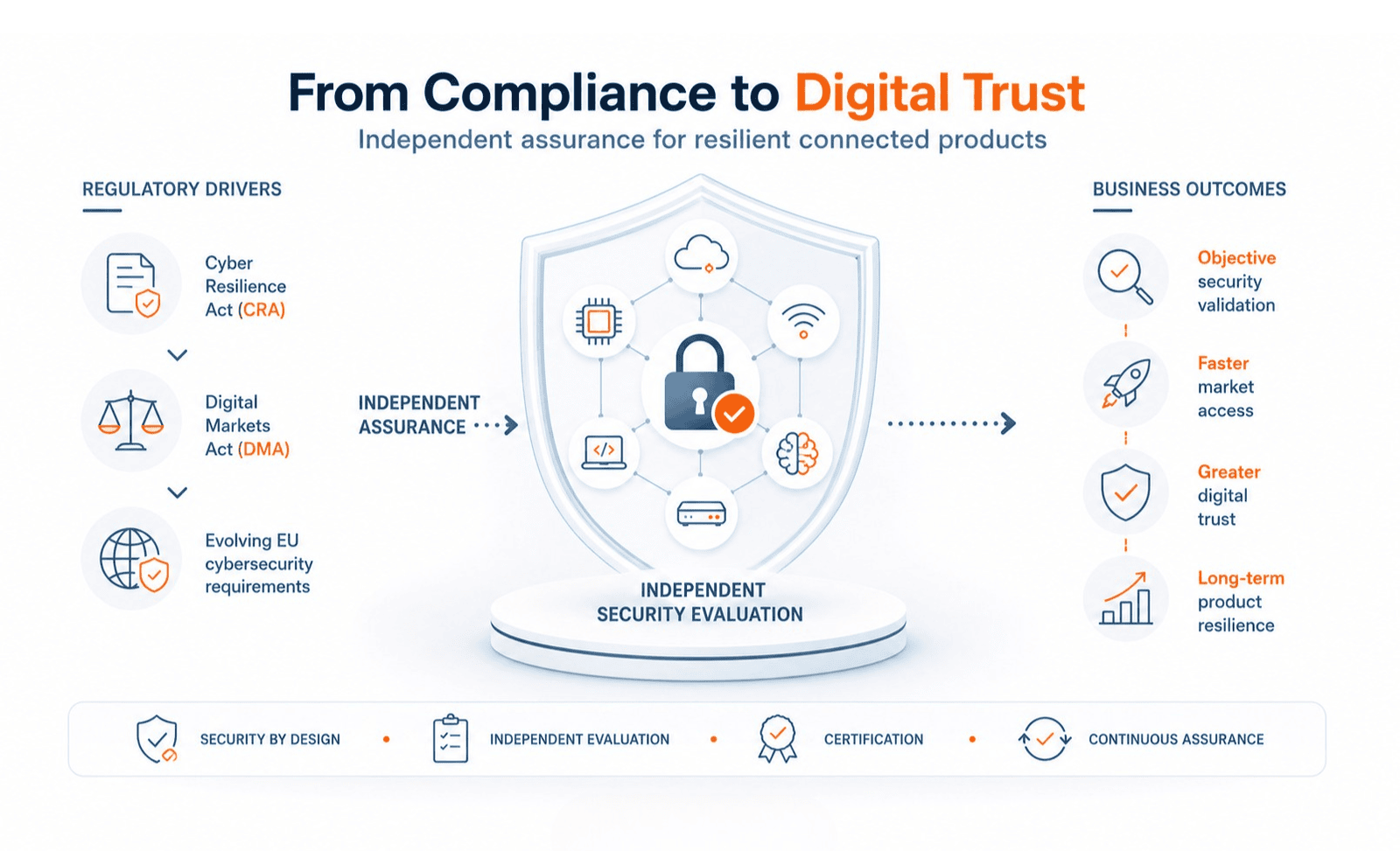
As digital systems become more complex, trust can no longer depend on self-declaration alone. Independent assessment is essential to connect regulatory expectations with real-world performance.
Under the CRA framework, some product categories may require third-party evaluation, while others can benefit from structured assessment methods aligned with European cybersecurity schemes. These approaches turn requirements into measurable results.
For Brightsight, independent assurance is more than a regulatory milestone; it makes security visible, measurable, and verifiable. It gives manufacturers clarity, users confidence, and the market greater consistency.
Connecting market structure and product trust
Connecting market structure and product trust
The Digital Markets Act focuses mainly on fairness and openness in digital markets, especially in relation to large platform providers. Although its aims differ from those of the CRA, the two frameworks are connected in practice.
A strong digital market must be open, competitive, and dependable. Users are more likely to engage with digital services when they trust both the market structure and the products offered within it. From this perspective, the DMA and CRA complement each other: one defines fair conditions for participation, while the other reinforces the reliability of digital products.
Together, they support a more coherent digital environment, where access, innovation, and security advance in parallel.
Using time to prepare meaningfully
Using time to prepare meaningfully
Recent changes to the EU AI Act timeline have underscored the value of preparation. The additional time before full implementation gives organizations an opportunity to understand the requirements more clearly, improve internal processes, and strengthen their approach to risk and assurance.
The same applies to the Cyber Resilience Act. Preparing for the CRA is not just about meeting deadlines; it is about creating the structures needed to sustain secure product development over time. This includes identifying gaps, aligning with relevant standards, and selecting appropriate assessment pathways.
Engaging with these elements early can make the transition smoother, more effective, and better aligned with long-term resilience.
Citizens as the constant reference point
Citizens as the constant reference point
Across these developments, one point remains constant: citizens are the ultimate stakeholders in the digital ecosystem. Through connected devices, software platforms, and emerging AI systems, people increasingly rely on technology in ways that shape everyday life.
Keeping these interactions secure and reliable is a shared responsibility. Regulation sets the framework, industry puts it into practice, and independent assurance helps verify the outcome. Together, these elements create an environment where trust is demonstrated, not assumed.
A perspective from Brightsight
A perspective from Brightsight
At Brightsight, we see today’s regulatory landscape as a move toward greater clarity and consistency in establishing digital trust. Structured requirements, combined with independent assessment, provide a foundation for innovation to grow with confidence.
When assurance is treated not only as a requirement but as a capability, organizations can move beyond reactive compliance and take a more proactive approach to security. This helps build a digital market that is both innovative and dependable for the people who rely on it every day.

Sergio Casanova
Chief Technical Officer, Brightsight
Preparing for CRA requirements?
Contact our team to discuss CRA evaluation and certification pathways for your product category.
Enjoyed this article?
Stay up to date with regulatory developments and evolving global cybersecurity requirements. Subscribe to our newsletter to receive the latest insights, updates, and announcements from Brightsight.