
As cybersecurity regulation continues to evolve across Europe, organizations developing products with digital elements are facing an increasingly urgent question: How can they efficiently prepare for compliance with the EU Cyber Resilience Act (CRA) without duplicating existing security efforts?
As cybersecurity regulation continues to evolve across Europe, organizations developing products with digital elements are facing an increasingly urgent question: How can they efficiently prepare for compliance with the EU Cyber Resilience Act (CRA) without duplicating existing security efforts?
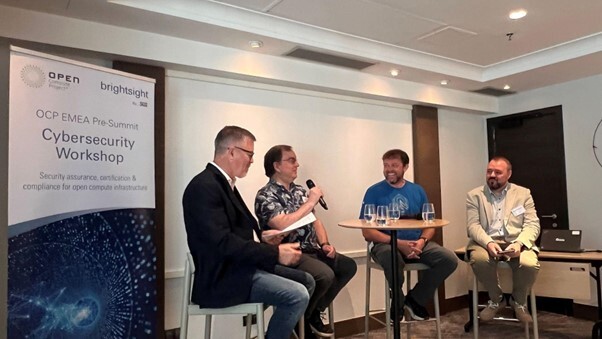
This question was at the center of the recent OCP EMEA Pre-Summit Cybersecurity Workshop, hosted by Brightsight ahead of the OCP EMEA Summit in Barcelona on 28 April. The event brought together experts from the Open Compute Project (OCP), Microsoft, Google, Nvidia, Qualcomm, Semidynamics and Brightsight to explore how industry-driven cybersecurity frameworks may support emerging regulatory requirements like the CRA.
The workshop focused on a practical and highly relevant topic: how OCP S.A.F.E. and the CRA can be effectively combined in real-world cybersecurity compliance scenarios.
The workshop focused on a practical and highly relevant topic: how OCP S.A.F.E. and the CRA can be effectively combined in real-world cybersecurity compliance scenarios.
Why this conversation matters now
The Cyber Resilience Act will introduce mandatory cybersecurity requirements for products with digital elements placed on the European market, with full application from 11 December, 2027. For manufacturers, cloud providers, infrastructure vendors, and technology developers, this means rethinking how cybersecurity assurance is demonstrated throughout the product lifecycle.
At the same time, many organizations already rely on security assessment frameworks such as OCP S.A.F.E. to strengthen cybersecurity assurance in cloud and data center ecosystems.
This raises an important industry question: Can OCP S.A.F.E. help accelerate the path toward CRA compliance?
The short answer discussed during the workshop was: yes — but with important considerations.
OCP S.A.F.E.: reducing duplication in security assessments
OCP S.A.F.E.: reducing duplication in security assessments
One of the strongest themes throughout the event was the need to reduce redundant cybersecurity assessments and enable the reuse of security evidence.
Today, vendors undergo multiple similar audits for different customers, creating inefficiencies, duplicated work, and differing security evaluation practices. OCP S.A.F.E. addresses this challenge by creating a more standardized approach to cybersecurity reviews for the data center ecosystem.
OCP S.A.F.E. and the CRA show substantial overlap in cybersecurity activities, creating opportunities to reduce time, effort, and cost. This is particularly the case when assessments are carried out by organizations with expertise in both frameworks, so are approved OCP S.A.F.E. Security Review Providers (SRPs) as well as accredited CRA Notified Bodies.
As discussed during the workshop, this approach offers clear advantages for organizations seeking scalable cybersecurity assurance — especially in complex supply chains where transparency and trusted evaluations are becoming increasingly important.
Where OCP S.A.F.E. aligns with CRA requirements
Where OCP S.A.F.E. aligns with CRA requirements
A key takeaway from the discussions was that OCP S.A.F.E. already covers several areas that closely align with CRA expectations.
These include:
- Risk and threat analysis during scoping phases
- Security reviews and conformance assessments
- Code and design documentation analysis
- Testing methodologies and supply chain security considerations
These activities can contribute significantly toward demonstrating cybersecurity maturity and preparing evidence relevant to CRA obligations.
The important gap: OCP S.A.F.E. is not CRA compliance
The important gap: OCP S.A.F.E. is not CRA compliance
Despite this strong overlap, an important distinction remains: OCP S.A.F.E. is not a substitute for CRA compliance.
While OCP S.A.F.E. focuses on technical security assurance, the CRA introduces additional requirements related to:
- Lifecycle management
- Vulnerability handling
- Compliance documentation
- Regulatory obligations
The CRA is ultimately a legal framework, meaning assessments must be defensible, structured, and aligned with formal regulatory expectations.
As one of the recurring themes of the event emphasized: OCP S.A.F.E. security and CRA compliance overlap, but they are not identical.
A pragmatic path toward CRA readiness
A pragmatic path toward CRA readiness
Rather than viewing OCP S.A.F.E. and CRA as separate or competing initiatives, the workshop proposed a more practical perspective: combine them strategically.
This means using OCP S.A.F.E. as a technical foundation, identifying remaining gaps against CRA requirements, and extending the evaluation scope where needed.
Brightsight explained how existing OCP S.A.F.E. results can be reused within broader certification and conformity processes, helping reduce duplication while maintaining regulatory rigor. In some cases, this reuse can also work in reverse—for example, applying CRA-related work to support OCP S.A.F.E. assessments.
For technology developers, this could represent a more efficient path to market readiness as CRA implementation progresses fast and December 2027 is closer than many think.
The workshop made one thing clear: the industry keeps shaping how cybersecurity schemes and regulatory frameworks can work together in practice and streamlining the effort into a mere single evaluation with multiple scheme reports and/or certifications.
However, collaboration between security review providers (SRPs), cyber security labs, certification bodies, technology vendors, and industry organizations will be essential to creating scalable and efficient re-use models.